HAIN CELESTIAL GROUP (HAIN)·Q2 2026 Earnings Summary
Hain Celestial Q2 FY2026: Stock Crashes 23% on Divestiture Execution Risk
February 9, 2026 · by Fintool AI Agent
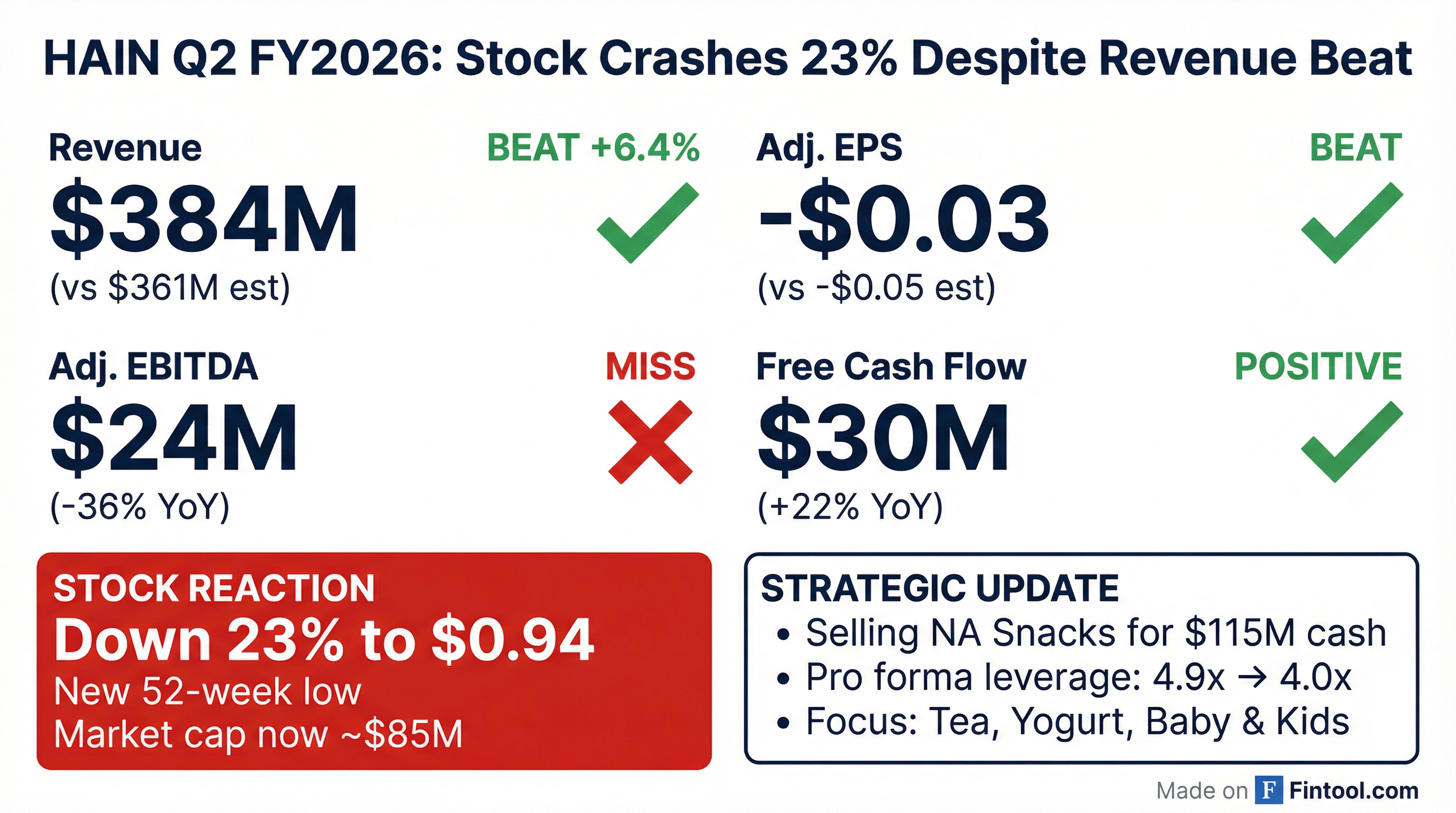
Hain Celestial (NASDAQ: HAIN) reported Q2 FY2026 results that topped lowered expectations, with revenue of $384M beating consensus by 6% and free cash flow surging 22% YoY to $30M. But the market wasn't buying it — shares crashed 23% to $0.94, hitting a new 52-week low and reducing market cap to just ~$85M. Investors are spooked by $20-25M in stranded costs from the snacks divestiture, a credit facility maturing in December 2026, and questions about whether this turnaround can work.
Did Hain Celestial Beat Earnings?
Revenue topped estimates despite organic sales declining 7%, as the street had braced for worse. The organic decline was driven by a 9-point volume/mix headwind, partially offset by 2 points of pricing.
Free cash flow was the standout — up 22% YoY to $30M, driven by improved working capital management. Days inventory outstanding improved to 75 days from 83 days in Q1 FY26 and 77 days a year ago. Management noted: "Each day of inventory is worth approximately $3.5 million."
Operational health is improving:
- Forecast accuracy rose 4 points Q/Q to the highest level "in several years"
- Service levels exceeded 96%, "best in recent history"
- SG&A down 13% YoY to 15.9% of net sales
 Ask Fintool AI Agent
How Did the Stock React?
The stock hit a new 52-week low despite beating on revenue and EPS. The market is signaling serious concerns about:
- Stranded costs — $20-25M annually that need to be eliminated over 6-12 months, creating short-term EBITDA pressure
- Refinancing risk — Credit facility matures December 2026, not in the distant future
- Turnaround fatigue — This is the 8th consecutive quarter of challenges; investors have lost patience
What Is the Snacks Divestiture?
On February 2nd, Hain announced a definitive agreement to sell its North American snacks business for $115M in cash to Snackrupters, a family-owned Canadian food manufacturer.
Brands being sold:
- Terra vegetable chips
- Sensible Portions Garden Veggie straws
- Garden of Eatin' organic chips
Why Divest Snacks? Management's Strategic Rationale
CEO Alison Lewis explained the strategic logic in detail during the Q&A:
"Snacks is fundamentally a demand creation category — an impulse category. You need heavy and intense innovation, strong marketing investment consistently, and DSD-like merchandising. The rest of our portfolio tends to be more center of store, which is fundamentally demand fulfillment. The demand's already there, and it's not quite as competitively intense."
"We had become over-reliant on the club channel. That club channel is really great when you have that business, really challenging when you don't."
Financial profile of snacks:
- Represented 22% of company net sales and 38% of North America segment
- Negligible EBITDA contribution over the last 12 months
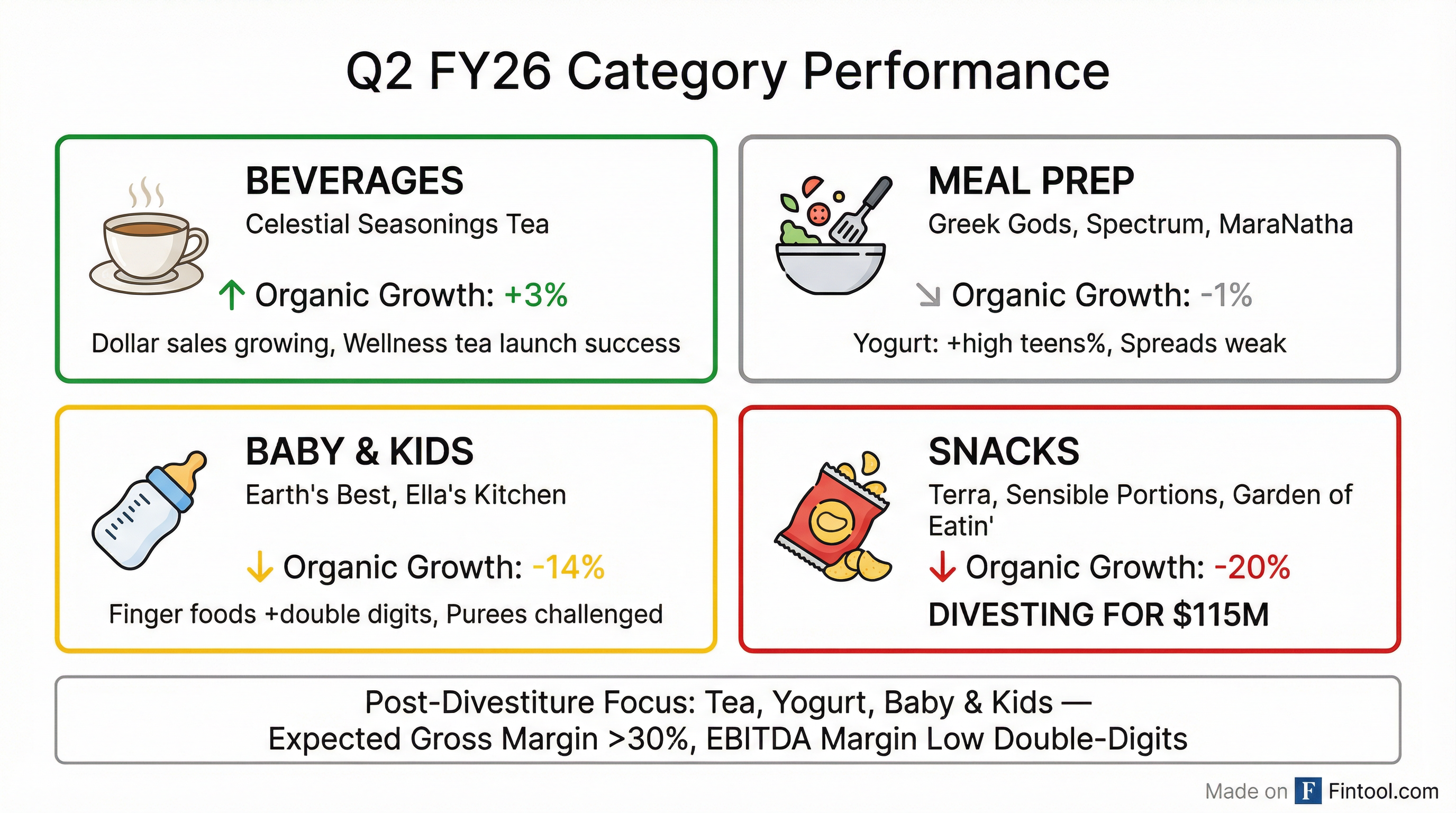
- Organic net sales down 20% YoY in Q2
Post-Divestiture Financial Profile
Important: The post-divestiture margin targets are after stranded costs are worked down. CFO Lee Boyce confirmed: "It is after the workdown of the stranded overhead impacts."
Stranded Cost Concerns
The market is focused on $20-25M in annual stranded costs:
"There will be some short-term pressure with the stranded costs, but we do have a very detailed plan to get those out in a short period of time. We said the 6-12 month period."
For modeling purposes, expect ~$5-6M per quarter of stranded overhead headwind until worked down.
How Did Segments Perform?
By Region
North America excluding snacks would have declined only 3% organically.
International showed sequential improvement from Q1's -4% organic decline, driven by moderation in baby & kids declines.
By Category — The Tale of Two Portfolios
The core is relatively healthy. Excluding snacks, Yves (which they're exiting), and specific category headwinds, organic sales were roughly flat.
Ask Fintool AI AgentWhat Are the Credit Facility Risks?
This is the key concern the market is pricing in. The credit facility matures December 2026 — just 10 months away.
Current Status:
- Net debt: $637M (declining to ~$522M post-divestiture)
- Leverage: 4.9x → ~4.0x pro forma
- Covenant limit: 5.5x (significant headroom)
- Available revolver: $144M
- Rate hedging: >50% hedged at 7.1%
- Net debt reduced by $140M over last 10 quarters
CFO Lee Boyce on refinancing:
"We have a disciplined approach to capital management and continue to prioritize debt reduction as the primary use of cash as we continue to act proactively to manage the upcoming maturity... We believe that aligning the maturity solution timing with the execution of the strategic review will enable us to achieve the strongest long-term outcome."
"We remain actively engaged with our lenders and are assessing opportunities to refinance our debt or extend maturities while evaluating potential capital raising or strategic transactions."
Key catalyst: $26M insurance proceeds received January 2nd that will help reduce debt.
What Did Management Guide?
FY2026 Outlook:
- No numeric guidance due to strategic review uncertainty
- Expects stronger organic net sales and EBITDA trends in 2H vs 1H
- Free cash flow expected to be positive for the full year
Catalysts for 2H Improvement:
-
Innovation launches:
- 7 new SKUs in big kids snacks (bites, ways, sticks) with added protein/fiber
- Single-serve Greek Gods yogurt expansion (60% incremental to category)
- Liquid coconut oil from Spectrum (25% of households only use coconut oil)
-
Cycling headwinds:
- UK Ella's baby food category challenges began May 2025 — start cycling in Q4 FY26
- NA formula supply recovery fully lapped this quarter
-
Pricing realization:
- Full benefit of pricing actions rolling in across baby, tea, and meal prep
Q&A Highlights
On Whether the Bank Group Pressured the Divestiture:
"It definitely wasn't pressured by the bank group. It was done — we talked about it, I think it was May, we kicked it off. We had a strategic review process. And were we strategically in a position with the right to win within that category?"
On Growth Sustainability:
CEO Alison Lewis on the path to growth:
"When you look at tea, we're a top three player in tea. We've shown that we can drive growth when we innovate. Our wellness innovations that we launched in June of last year are driving share growth. When you look at our yogurt business — that's a standout business for us with double-digit growth in whole milk, which is a growing area of interest where whole fats are something consumers are moving more towards."
On Pricing Strategy:
"Price is relative to the value that you deliver. When we're bringing innovation or renovation and seeing that added value come into products, we're seeing an ability to sustain price or even price up. The key is not about decreasing or increasing prices — it's about what value we're bringing and what the consumer is willing to pay."
On Tax Considerations for Further Asset Sales:
"There are no concerning tax considerations at this point." — This opens the door to additional divestitures.
What Are the Key Risks?
- Refinancing execution — December 2026 maturity with ~$500M+ in debt to address
- Stranded cost drag — $5-6M/quarter headwind until eliminated
- Category headwinds — Baby & kids facing industry-wide puree softness, UK wet baby decline
- Execution risk — 8th consecutive challenging quarter; credibility at stake
- Market cap < net debt — Stock at $85M market cap vs $500M+ net debt = severe distress signal
- Further dilution risk — Company mentioned "evaluating potential capital raising"
The Bottom Line
Hain Celestial beat lowered expectations, but the stock's 23% crash tells you everything about market sentiment. At $0.94 and ~$85M market cap, the stock trades at severe distress levels — well below the $115M cash coming from the snacks sale alone.
Bull case: Simplified portfolio with >30% gross margins, successful refinancing, 2H inflection from innovation and cycling, and $115M divestiture proceeds reducing debt to manageable levels.
Bear case: Stranded costs depress near-term EBITDA, refinancing proves costly or dilutive, categories continue declining, and management has cried wolf too many times on the turnaround.
Watch for: Divestiture close (expected February), refinancing announcement, Q3 results showing sequential improvement.
Ask Fintool AI AgentData sourced from Hain Celestial Q2 FY2026 earnings call transcript, press release, and S&P Global.